The 1,000-Mile Great Lakes Adventures

Showing posts with label invasive species. Show all posts

Thursday, May 20, 2021

Invasive Plants


Loreen Niewenhuis is an author, adventurer, and dynamic speaker. 

She has completed a trilogy of 1,000-mile journeys exploring the Great Lakes and has authored three books about these adventures. 


To learn more about her work, or to engage her as a speaker, go to 

http://www.laketrek.com/great-lakes-speaker/


I like to volunteer to maintain or improve the trails that I hike near my home in Traverse City. Sure, I always pick up trash when I hike, but I also actively search for opportunities to work on these trails. One time I even got to help put in a new trail in one of Leelanau Conservancy's properties. 


This week, I joined with volunteers to help remove the invasive garlic mustard plant from Clay Cliffs Natural Area. This is one of my favorite trails within the Leelanau Conservancy.

Since it had rained the night before, pulling up these invasive plants was pretty easy and we cleared large patches of it.

Here are some photos from the work day:


Go HERE to view a tutorial on how to identify and remove invasive garlic mustard plants.

Wednesday, February 24, 2021

Hemlock Wooly Adelgid


Loreen Niewenhuis is an author, adventurer, and dynamic speaker. 

She has completed a trilogy of 1,000-mile journeys exploring the Great Lakes and has authored three books about these adventures. 


To learn more about her work, or to engage her as a speaker, go to 

http://www.laketrek.com/great-lakes-speaker/


There is an invasive species that has been decimating hemlock trees in America for decades. It is a small insect similar to an aphid called the wooly adelgid.
This insect is native to Asia and made its way to America via imported plants in the 1950s. It has  been slowly spreading for decades and has made its way to northern Michigan. This pest has recently been found in Sleeping Bear Dunes National Lakeshore. 

I often hike in and around Sleeping Bear Dunes and have seen many mature hemlock trees in these forests.

One of my favorite hikes is at the Traverse City Commons, and there are some massive hemlocks there. 

Check out the view from the wooded dunes:


There is a hemlock that I visit there, and after the recent storms, I was sorry to see it had developed a crack in the trunk. 


These trees are the preferred feast for the wooly adelgid. They congregate on the underside of the needles and suck the sap out of the tree. The needles turn brown and new growth is inhibited. Infested trees can die within 4-10 years.

Trees can be treated with pesticide and can be saved if infestation is caught early.

Severe winters helped to slow the spread of this pest.


Update (info from NPS):  Though the tiny insects don’t move far on their own, they can be blown by wind or hitchhike on birds or mammals – including humans - that come into contact with an infested branch. In a similar way, cars, boats, tents, or RVs parked under infested trees may be able to transport the insects to new locations.


So, clean your boots and NEVER transport wood from one area to another.

Sunday, April 26, 2015

The Day I Held a Lamprey

The United States Geological Service (USGS)
 has a research facility on northern Lake Huron dedicated to studying and controlling the invasive lamprey. This creature (it resembles an eel, but is actually in a separate class) suctions on to large fish and literally sucks the life out of them.

I interviewed Dr. Mike Hansen, Field Station Supervisor, for my second book. 

While back in Rogers City recently to give a talk at the library, I stopped in at the facility to see 
Dr. Hansen and tour the facility.

USGS Station signs

 Lamprey entered Lake Erie through the Welland Canal in the 1930s. Prior to this, the lamprey had populated Lake Ontario, but were prevented from moving into the other lakes by Niagara River and the mighty Niagara Falls.

Lauren (a communications rep) with the eggs from just one female lamprey 

A single lamprey lays tens of thousands of eggs. It is impossible to eradicate them, so controlling the population is the best option.

Lamprey are kept in these containers for study

 This facility studies the lamprey, organizes monitoring of streams and rivers where they spawn, and coordinates the treatment of waterways to kill lamprey when they are in the larval stage.

It's best to keep your eye on the lamprey...especially if it's got an eye on you

The multi-toothed suction mouth of the lamprey


Juvenile lamprey. Not so scary, but they'll latch on faster than the adults 

You can stop in and get a tour of the station located on Hammond Bay just north of Rogers City on Wednesdays and Thursdays at 2pm, or by appointment.
Learn more about the station HERE. 
And read about this important work in my second book, A 1,000-Mile Great Lakes Walk.

Sunday, November 23, 2014

The Invasive Round Goby

There are many invasive species in our 
Great Lakes. The majority of them were transported here in ballast tanks of ships from freshwater ports all over the world.

One of these recent hitchhikers is the Round Goby native to central Eurasia. They arrived in the 1990s and in less than a decade had spread to four of the five Great Lakes.

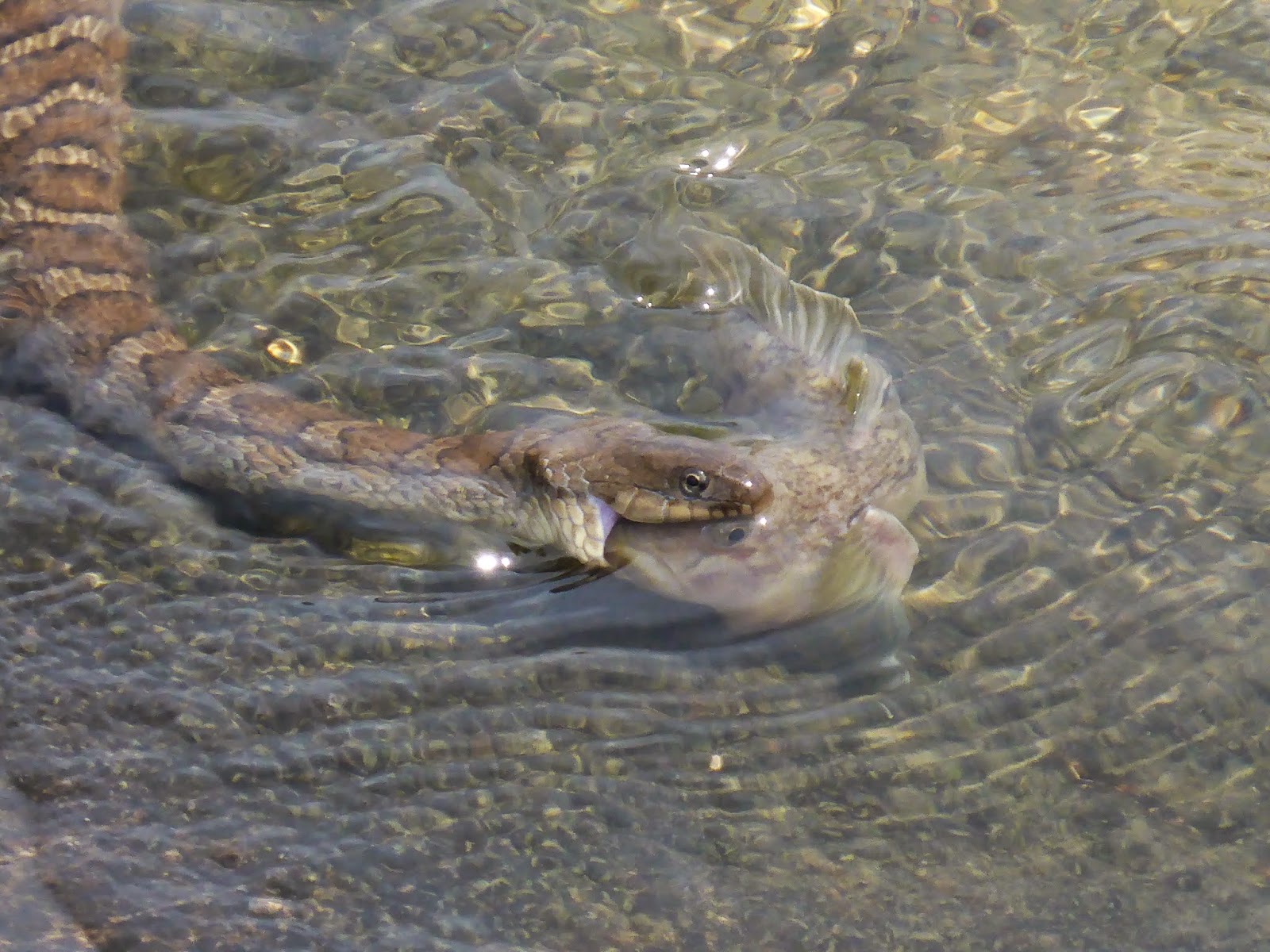
Water snakes are loving this fish...for dinner. Since Gobies tend to just sit on the rocks on the bottom of the lake, the clever water snakes sneak up on them and grab them by the head.


They then drag them to land and swallow them whole. I captured this "revenge on invasive Gobies" struggle on Manitoulin Island.


And, no, the Goby doesn't look too happy about it.

Loreen Niewenhuis is an author, adventurer, and Great Lakes speaker. She has completed a trilogy of 1,000-mile adventures exploring the Great Lakes and has written three books about the Great Lakes [A 1,000-Mile Walk on the Beach *a Heartland Indie Bestseller*, A 1,000-Mile Great Lakes Walk *winner of the Great Lakes Great Reads Award*, and A 1,000-Mile Great Lakes Island Adventure]. To learn more about her work, or to book her as a speaker, go to http://LakeTrek.com


Saturday, December 7, 2013

The Problem of Invasive Species

I'm often asked what is the most pressing problem 
for our Great Lakes. 
My answer:
Invasive species.

When a new species is dropped into an ecosystem in which it has never existed, it often has a huge survival advantage and can toss the entire system out of balance for a time. 

As I've walked the shorelines of our vast inland seas, I've often seen evidence of the destructive power of invasives.

While vigilance and legislation (e.g. strict ballast water treatment laws) can help prevent transport of new species into the Great Lakes Basin, what can be done to control them once they have established a hold in the lakes?

INVASIVEORE.ORG has some ideas...
and recipes!

From their website:  
Our mission here at Invasivore is to be your one-stop guide for devouring Invasive Species, those organisms which have been moved around the world, damaging their new surroundings.  Think of it as reasonable revenge for the harm these species cause.  The word “invasivore” comes from combining “Invasive Species” with the latin for “devour” as in “carnivore”.  Thus invasivore = one who eats invasive species.
From prehistoric times, humans have had an amazing track-record of severely reducing the populations of species we eat.  Indeed, it seems that much of the time we can’t stop ourselves.  Can we tap that hunger to reduce the impacts of harmful invasive species?  We think the answer is Yes!

Alewife, an invasive species native to the Atlantic Ocean long established in the Great Lakes


Check out all the recipes on their site, including one for 

Wednesday, May 23, 2012

Freakin' Phragmites!

Loreen Niewenhuis is an author, adventurer, and Great Lakes speaker. She has completed a trilogy of 1,000-mile adventures exploring the Great Lakes and has written three books about the Great Lakes [A 1,000-Mile Walk on the Beach *a Heartland Indie Bestseller*, A 1,000-Mile Great Lakes Walk *winner of the Great Lakes Great Reads Award*, and A 1,000-Mile Great Lakes Island Adventure]. To learn more about her work, or to book her as a speaker, go to http://LakeTrek.com


I was discouraged to see so much of the invasive grass -- phragmites -- along the shores I've walked so far.  

It was along the Great Lakes, along inland canals and ditches, along smaller lakes and large rivers.  

Invasive species have changed and warped and altered the ecosystem of our Great Lakes.  I spoke to one woman who remembered that the shores near the town of Sebewaing were free of  phragmites a decade ago.  Today the waterways are choked with this invasive grass.  
There had a to be a window of time when the species was first introduced and could have been easily controlled and then eradicated.  That window of opportunity has passed and now eradication will take a concerted effort over many years.   

Sunday, January 22, 2012

Invasion of the Great Lakes: Quagga mussels least known, most dangerous invader

The invasive quagga mussel has colonized all of the Great Lakes, tossing a wrench into the precarious balance of their ecosystems. This mussel is native to the Ukraine and was given a free ride to our vast Inland Seas in the ballast water of a ship bringing goods from far off ports.


Read the most recent update HERE.
This final photo shows a mass of quagga mussels colonizing whatever they can find in the lakes. After a storm this fall, the beach along Lake Michigan was littered with these long strands of grasses and mussels. My boot is included in the shot to give scale to the cluster of mussels.


Friday, December 9, 2011

Webinar takes on Clean Water Act rollbacks, invasive species, SS Badger

Click HERE to get access to a recent webinar about important issues
that impact our Great Lakes.


There are efforts to weaken the Clean Water Act at a time when our lakes are approaching a crisis due to invasive species, algae blooms, and other threats.

Be informed.
Contact your representatives in Congress.
View from the Empire Bluff Trail

Wednesday, October 12, 2011

Attack of the QUAGGAS!

One of the questions I often get at while on my book tour is:

What's the most pressing issue
facing our Great Lakes?


There are many issues facing our lakes including loss of habitat for wildlife, loss of buffering wetlands, toxic sites, invasive species (both present and threatening to enter the lakes), over-development of the lakeshore, and ongoing pollution.

But if I could magically fix just one thing, I would eradicate the invasive mussels in our great lakes. Specifically, the quagga mussels (in photos) that have so completely colonized four of the lakes and are eroding the foundation of the food web.


THIS ARTICLE
gives more details about how the quaggas have thrived in our Great Lakes. It is estimated that there are over 400 TRILLION quaggas in Lake Michigan alone.


That's TRILLION with a "T"

What can be done about the quaggas? Unfortunately, it would take a magic wand to get rid of these invasive mussels. They spread rapidly, filter food endlessly out of the water, and reproduce prodigiously.

From the article:

"Quaggas are causing the biggest changes we've ever seen in Lake Michigan," said Tom Nalepa, a research scientist at the National Oceanic and Atmospheric Administration's Great Lakes Environmental Research Laboratory who has studied the lake for more than 30 years. "The numbers are still going up. We are going to see more severe impacts."
The havoc they have created includes an increase in toxic algae, a loss of tiny plants and animals that fish feed on, a decline in prey fish, and skinnier game and commercial fish.

Short of a disease or poison that could be targeted at them in the lakes' depths, quaggas are here to stay, Nalepa said.

But they represent a lesson for the future.

Of the 186 invasive species in the Great Lakes, two-thirds came from ships in the St. Lawrence Seaway, which pick up ballast water in foreign ports and discharge it into the Great Lakes. "We need to cut off the tap," said Kerfoot.


Saturday, August 27, 2011

A Win-Win-Win-Win Situation for the Great Lakes

I have blogged about the Great Lakes Restoration Initiative (GLRI) several times. This is the largest investment into our Great Lakes in two decades and is a five-year plan to fund programs to improve the health of our lakes. The funding targets five specific areas:

  1. Cleaning up toxics and areas of concern
  2. Combating invasive species
  3. Promoting nearshore health by protecting watersheds from polluted run-off
  4. Restoring wetlands and other habitats
  5. Working with partners on outreach
With the stalled economy, this ambitious program has been scaled back in the budget each of the years it has been included thus far. Still, it is doing a lot of good on many levels in the Great Lakes Region.

On August 23, the EPA announced that the GLRI is setting aside $6 million for federal agencies to sign up unemployed workers to complete projects "in federally-protected areas, on tribal lands and in Areas of Concern in the Great Lakes Basin."

"These projects will help to restore the Great Lakes and put Americans back to work," said EPA Great Lakes National Program Manager and Regional Administrator Susan hedman. "In a sense, we will be using these funds to create a small-scale 21st century Civilian Conservation Corps."

This complex approach to a complex set of problems will benefit the Great Lakes Region on many levels. As I've mentioned before, the Brookings Institution (a nonpartisan group) estimated that for every $1 invested in the GLRI will give back $2 to the region.

This benefit must actually increase if the GLRI is used to employ the unemployed in the region. Those wages will be taxed in the region supporting schools, roads, and other community services. Those wages will be spent in the region supporting local businesses.

Win-win-win-win.

Contact your represenatives in support of the GLRI, and learn more about the program and the projects it funds HERE.


Friday, March 4, 2011

Budget Cuts Effect the GLRI

I've blogged several times about the
Great Lakes Restoration Initiative (GLRI).


This is the ten-year, $5 billion program to improve the health of the Great Lakes. With Congress cutting away at the budget, the GLRI is on the chopping block.


These are tough economic times, but the GLRI is an investment not only into the lakes but into the economy they support.


It is estimated that 15% of the jobs in Michigan
are related to the Great Lakes.


Jim Diana, Director of the Michigan Sea Grant, points out research done by The Brookings Institute:


"The Brookings Institute estimated that $18 billion to $31 billion in economic benefits would result from Great Lakes restoration, at a ratio of about 2 to1, benefit to cost. The investment for restoration is a one-time cost, while the benefits increase with time."


How many other budget line items promise
to give BACK to the country?


Let your representatives know that you support the GLRI and that it is a good investment in the economy of the Great Lakes.

Monday, January 31, 2011

Invasive Species

The Asian carp is the 'poster child' of invasive species, but do you know that there are over 150 non-native species already established in the Great Lakes? From bivalves from Russia, to plants from Europe, to fresh water-tolerant species from the Atlantic, our Great Lakes are already populated with invasives that continually weaken and erode the ecosystem.

The Asian carp is a big and current threat. It has been making its way to the Great Lakes for many years and is now very near Lake Michigan.

A permanent solution IS possible.

Tom Kelly, Executive Director of the Inland Seas Education Center in Suttons Bay, Michigan, presented his recommendations at the recent US Army Corps of Engineers and Mississippi River Interbasin Study meeting in Traverse City.

See his recommendations here:

http://schoolship.blogspot.com/2011/01/tom-kellys-comments-to-glmris-scoping.html

Monday, January 17, 2011

Did You Know...

...there are over 150 invasive species in the Great Lakes. These range from fish like the alewife, to plants like the purple loosestrife, to mussels like the zebra and quagga.


...zebra mussels are native to the lakes in southeast Russia. They have been transported to the Great Lakes in the ballast water of ships.


...zebra mussels can produce up to 1 million eggs a year. All of the white in the photo here is from dead zebra mussel shells both in the water and piled up in a long windrow. This was just south of Cross Village, Michigan.


This photo shows a mixture of zebra and snail shells along with stones from the shore of Lake Michigan.


Wednesday, December 8, 2010

Quagga Mussels


I've been reading a lot lately about the quagga mussel. This filter-feeding bivalve is native to the Ukraine and was transported into the Great Lakes in a ship's ballast water. It was first seen in Lake Erie in 1989. Since then, the quaggas have populated all five of the Great Lakes. Since then it has spread to the Mississippi River, to waterways in Colorado, and even as far as California.

As with any species transported into an ecosystem where it has not been before, the invader often has a competitive advantage. This is because it there may not be natural predators to keep the invader's population in check.

Transported over to the Great Lakes and dumped into these deep, phytoplankton-rich waters, the quaggas multiplied and spread.

It is now estimated that there are 900 TRILLION quaggas
in Lake Michigan.

Seriously. They number in the HUNDREDS of TRILLIONS, and they are crashing the lake's ecosystem.

Read more about this crisis HERE.

And here's one of the most comprehensive articles I've ever read on dealing with invasive species. It was in a recent issue of Milwaukee's Journal Sentinel.

Wednesday, November 3, 2010

The Sea Lamprey STARS on Dirty Jobs

The sea lamprey is the focus of the most recent episode of Discovery Channel's "Dirty Jobs"

Mike Rowe, the show's host and willing participant in these 'dirty jobs,' will shadow scientists as they attempt to corral and control the lamprey population in the Great Lakes.

The sea lamprey was one of the earliest species to travel the shipping canals dug to allow transport of goods from the lakes out into the St. Lawrence Seaway. These waterways allowed the lamprey to enter and colonize the lakes back in the 1920s.

Lamprey attach themselves to large fish and suck the life out of them. By the 1950s, the lamprey had significantly depleted the lakes of large, predator fish. This allowed the population of alewives (a smaller fish) to explode.

Controlling the lamprey population and restocking the lakes with trout and salmon allowed some semblance of balance to return.

(Photo is from the Inland Seas Education Center located in Suttons Bay, Michigan)


Wednesday, June 30, 2010

Asian Carp within 6 Miles of Lake Michigan

A 20 pound, 34 inch Asian carp has been found PAST the electric barriers, just 6 miles from Lake Michigan.

The Honorable Senator Stabenow's call for action is below. In a letter she sent, she says:

"The Permanent Prevention of Asian Carp Act requires the Army Corps of Engineers to follow the recommendations of top experts in the field and expedite their study detailing the engineering options to permanently separate the Mississippi River from the Great Lakes."


Thursday, May 6, 2010

Poisons and Nets and Shocks

The Asian carp were imported to eat algae in fish farms and sanitation pools and were flushed by floods into the Mississippi River.

The Asian carp have been spawning and spreading from the waters of the southern Mississippi River for decades.

So, for decades they have been reproducing and migrating up the Mississippi, supplanting native fish.

So -- HUGE leap of logic -- the Asian carp have made their way to the rivers and canals around Chicago. They've even been able to get past the electric barriers set up kind of last minute to stop them from entering Lake Michigan.

So, now, poisons and nets and shocks will be employed to keep them from colonizing the Great Lakes. Poisoning in the Cal-Sag channel will begin on May 20. Nets and electro-fishing will be employed along the Chicago River soon.

I find it hard to believe that a more elegant solution wasn't available sooner. Like, maybe, only using male fish in the ponds in the first place (if they escape, they can't reproduce). Or, maybe, doing one poisoning immediately following the flood that spilled these voracious fish from the other side of the world into the Mississippi. Maybe they could have been dealt with at the source instead of letting them colonize hundreds of miles of waterways.

This is, of course, hindsight.

I'm just a little put out that these fish are now knocking on the door to my lake, Lake Michigan.

Poisons and Nets and Shocks, indeed.

Wednesday, February 17, 2010

The Asian Carp Saga Continues

I watched the live video feed from the public meeting in Ypsilanti, today to discuss plans and get recommendations on Asian carp control efforts.

Who was there: Senior representatives from
International Joint Commission;
U.S. Environmental Protection Agency;
U.S. Fish and Wildlife Service;
U.S. Army Corps of Engineers;
U.S. Coast Guard;
Great Lakes states, provinces, municipalities and tribes
(invited);
White House Council on Environmental Quality; and
Scientific experts

It seems that everyone (regardless of their personal interests) want to keep the invasive carp from establishing themselves in Lake Michigan. That was encouraging. What's disheartening is that there is little concensus on how that can be definitively accomplished.

Senator Debbie Stabenow made a personal appearance at the meeting and addressed the panel with not only a passionate defense of the lake, but with the offer of funds needed to solve this problem, to ensure that the carp never establish themselves in the lake. As I've mentioned here before, she has introduced legislation to keep the carp out of the lakes.

Well done, Senator Stabenow.

Today's meeting will be posted soon on this site: http://www.epa.gov/greatlakes/live/carp_chicago/index.html
and the February 12 meeting in Chicago is already archived there.

One very good idea that got around the 'close the locks/don't close the locks' polarizing argument was to back the carp up by eradicating them further back in the canals and to putting more barriers (either sonic or electric) further away from the lakeshore.

Almost $80 million has been allocated to keeping these invasive fish out of the Great Lakes.

Tuesday, January 12, 2010

Asian Carp before the Supreme Court


This Friday, January 15, the case to keep the Asian Carp out of Lake Michigan will be argued before the Supreme Court. [Since this is a matter involving more than one state it must be judged in the highest court.] The state of Michigan is requesting that the locks on the canals around Chicago be shut to permanently bar the fish from entering the lake. The argument to keep the canals open will site that closing the canals will hurt the economy by making goods transported through the locks more expensive since they will have to be moved via rail or truck.

The non-profit group The Alliance for the Great Lakes has noted that only a small proportion of goods transported around Chicago actually go through the locks, and the the lake could be cut off from the canals minimal impact on the flow of goods.

Let us all hope that the court is more focused on the future of the lake than anything else.

Sign the online petition to stop the Asian carp from reaching lake Michigan: http://stopasiancarp.com/

Update: The Supreme Court sided with the state of Illinois and will NOT order the locks to be closed.

Tuesday, December 22, 2009

Handfuls of Lake Michigan


All along Lake Michigan's shoreline, when I found interesting things I would scoop up a handful and take a photo.

Here are just a few of these handfuls, shells and rocks and tumbled slag, found in various spots along the lakeshore.


The first photo is a mix of rocks and shells (both the invasive zebra mussel and native snail shells).


The second photo is unmistakably zebra mussels found near Cross Village on the NW of Michigan's lower peninsula. It was here that I came across the largest deposit of these shells, a windrow deposited by wind and wave that stretched for over 50 feet along the shore.

The next photo is of the colorful tumbled slag cast off from the iron smelting operation in the town of Fayette which operated for over 20 years in the later part of the 19th century. This site is on the Garden Peninsula in Michigan's UP.


The next photo is of a handful of tumbled slate found south of Michigan's Fisherman's Island State Park. This was the only place along the lakeshore where I came across this unusual stone in this quantity. There were walls of the shale, sometimes with tiny waterfalls cascading down the face.

I've been asked several times about the place to find the most colorful stones along the lake. This last handful is from the beach in the city of Charlevoix. For variety of color and the fact that all the stone had been so delightfully tumbled, I'd rate this beach among the best for interesting rocks.