Friday, December 4, 2009

The Asian Carp -- closer to the lake than previously thought

One Asian carp was found in the area that was treated with Rotenone (a fish poison).

The connection between Lake Michigan and the Mississippi River system is manmade. It is the Sanitary and Ship Canal and it was dug in the 1890s. We are able to disconnect these two water systems. Shipping commodities around the Chicago area would have to be modified a bit, but most of the shipping within the canal systems does NOT go out into the lake anyway.

Even a temporary closure of the canals would be wise in order to determine how well the electric barriers are working and how they can be optimized or augmented with other barriers.

Here is a list of the decision makers in this battle:

Illinois Department of Natural Resources

For questions about Rotenone application
Stacey Solano (217) 299-3733 stacey.solano@illinois.gov
Chris McCloud (217) 299-7128 chris.mccloud@illinois.gov

U.S. Army Corps of Engineers
For questions about the electric barriers/maintenance
Lynne Whelan (312) 846-5330 lynne.e.whelan@usace.army.mil

U.S. Coast Guard
For questions about the Chicago Sanitary and Ship Canal closure
Lt. Dave French (216) 902-6021 David.M.French@uscg.mil

U.S. Environmental Protection Agency
For questions about the impact of Asian carp on the Great Lakes
Anne Rowan (312) 353-9391 Rowan.Anne@epamail.epa.gov
Phillippa Cannon (312) 353-6218 (773) 271-3370 (cell) Cannon.Phillippa@epamail.epa.gov

U.S. Fish and Wildlife Service
For questions about the impact of Asian carp on the Great Lakes
Ashley P. Spratt (612) 713-5314 ashley_spratt@fws.gov


Wednesday, December 2, 2009

Asian Carp Get Closer to Lake Michigan

We have a rare opportunity here. In the past, we haven't learned about new invasive species in the Great Lakes until it has established itself and, usually, destabilized the ecosystem even further. With the Asian Carp (which is making its way toward Lake Michigan via the Sanitary and Ship Canal), we have a window of time in which to take action to prevent their arrival in the lake.

There are currently two electric barriers in the canal to stop the fish from reaching the lake, but there is concern that they may not be entirely effective. Recent testing of the canal water was positive for the asian carp DNA. This means that the fish are closer to the lake than previously thought.

(Photo: The Calumet River flowing into Lake Michigan)

The decisive step of poisoning a stretch of the canal to kill all fish there is happening today. This will allow maintenance to be done on the electric barriers and also allow researchers to find out if any of the carp have reached the barriers. Read about it in the Detroit Free Press article. This is not a permanent fix for the problem, though, and flooding of the Des Plaines River could sweep the fish past the electric barriers.

Shipping in the Great Lakes is a multi-billion dollar industry. It is this industry that has transported the majority of the invasive species (from around the world) to the Great Lakes. The zebra mussel (from the Caspian Sea), the quagga mussel (from the Ukraine), and the round goby (from Europe) all hitched rides in the ballast water of ships from fresh water ports around the world and were then dumped into our lakes. How costly is it to treat ballast water so that nothing survives from these far off ports to attack our lakes? Certainly nowhere near the billions of dollars that just these three invasive species have cost the Great Lakes.

There are two major ports on the south end of the lake. I walked by both of them. Ocean going vessels can dock here, then barges take goods inland via canals and rivers to the Mississippi. This is a multi-billion dollar industry. How costly, really, would it be to seal off the canals permanently and transport cargo a short way overland to nearby rivers that connect to the Mississippi? It can't be as costly as turning our lakes over to these voracious, invasive fish.

Monday, November 30, 2009

Sunset from Leland

video

Here is another clip of a sunset, this time from the beach at the city of Leland. From this vantage point, the sun sets between Pyramid Point and the Manitou Islands.

This area is probably my favorite stretch of Lake Michigan shoreline. The Sleeping Bear Dune National Lakeshore is along here and the stunning Leelanau Peninsula. The land here shows the obvious shaping of the glaciers that pushed through this area, then receded several times over 10,000 years ago.

Saturday, November 28, 2009

Lake Michigan Sunset

video

While up at the Grand Traverse Lighthouse, I was treated to some spectacular Lake Michigan sunsets. I filmed this one across Cat Head Bay, just southwest of the lighthouse.

Enjoy!

**For a real master photographer's eye on this gorgeous area, check out Ken Scott's work**

Friday, November 27, 2009

The Mystery of the Grooved Rocks

While volunteering up at the Grand Traverse Lighthouse, I took some time to walk the shoreline. The director of the lighthouse pointed out an unusual stone in the shallow water near the lighthouse. This tan colored stone (first photo) had been worked at one end to form a groove. The story behind a rock like this was that the Native Americans would groove rocks along the shoreline where they wanted to tie up their canoes. This rock would probably been stood on end so that the groove would be on top, ready for a rope to be looped around it.

I hiked the 5 miles from the lighthouse to the other end of Cat Head Bay, and on that point found this second rock. It also looks like it has had grooves worked into it, and it was near the point which would have been a land feature easily recognized from the lake.


This second rock was quite large. My boot is in the shot to give a sense of its scale.


On the hike back from the point, I was treated to this fireball sunset.

Tuesday, November 24, 2009

Are You the First?

I was often asked as I walked around Lake Michigan if I was the first to do this. I had heard of many people biking around the lake and had read several books have been written by people who have driven around all five Great Lakes. It was back in February, though, when I heard a rumor about a woman who had walked around Lake Michigan, and possibly all five of the Great Lakes. And I finally had some time to track down the woman behind the story.

She is Josephine Mandamin, a member of the Anishinabe tribe in Canada and she did, indeed, organize and participate in a Water Walk, taking on one Great Lake a year between 2003 and 2008. This epic undertaking was prompted by a prophesy from a tribal elder that the waters of the Great Lakes would die within 30 years if action wasn't taken on their behalf. Mandamin's action was to raise awareness about the problems facing the lakes by walking around each one. She was joined each year by a small group from her tribe on her walks. They walked mostly on main roads so that they would pass through communities where Mandamin could share her message that "the water is sick...and people need to really fight for that water, to speak for that water, to love that water."

While I walked mostly alone and mainly on the shoreline, I hope that our paths overlapped at some point. It would be my honor to have followed in this amazing woman's footsteps, and I share her concern and love for Lake Michigan.

Sunday, November 22, 2009

The Lake Gives Apples


On my way back home from the Grand Traverse Lighthouse, I stopped in at an apple orchard. Christmas Cove Farm grows over 240 varieties of apples on their land near the tip of the Leelanau Peninsula.

There is rich history with many of the varieties grown there. The Zabergau was grown as far back as the 1700s in Germany. Snow has its roots in France even further back into the 1600s.


Rambo
was a variety spread through this country by none other than Johnny Appleseed.


And Thomas Jefferson cultivated the Spitzenburg variety at Monticello.


Michigan -- especially the west side of the state -- is known for its rich agricultural tradition. This bountiful harvest is linked directly to Lake Michigan. It is the deep, fresh water of the lake that mediates the weather for this growing zone, and the glaciers that formed the lake also shaped the land for agriculture.

Wednesday, November 18, 2009

Independent Bookstores Near the Lighthouse

I had the opportunity to visit two independent bookstores during the week I was volunteering at the lighthouse. Brilliant Books, in Suttons Bay, was a store that I had stopped in while on the Lake Trek. This time, I had the pleasure of meeting the owner, Peter Makin. We had a nice chat about his store and independent bookstores in general.

Brilliant Books was running a book fair while I was there. A percentage of the proceeds were going to local schools. At a time when Michigan's economy is struggling and school budgets are being slashed to the bone (and beyond), it was encouraging to know that Brilliant Books was pitching in to help local schools.

Peter also invited me back to do a reading and book signing during their Friday Night Series at Brilliant Books. I'm honored to be asked, and will look forward to being part of this series next year after my book has been published.

And then I stopped in at Dog Ears Books in Northport. There I met Pamela and her dog (whom I assume is the 'Dog' in the 'Dog Ears' title). This store has a large collection of used and new books and I found a signed copy of Jerry Dennis' It's Raining Frogs and Fishes.

I'm a big fan of Jerry Dennis' work, so it was great to hold this out-of-print title, then take it home with me.

Saturday, November 14, 2009

To the Lighthouse...


I spent last week living and working at the Grand Traverse Lighthouse located on the northern tip of Michigan's Leelanau Peninsula. This lighthouse warned sailors of the shallow waters and guided them into the safety of Grand Traverse Bay from the 1850s until it was decommissioned in the 1970s.

We volunteers had a variety of tasks over the week. We staffed the gift shop and museum, put up decorations for the holidays, raked leaves, and helped install new museum displays.

Of course, there was time to hike the lakeshore and watch the sunset from the lighthouse tower. It was a full week, and I'll be posting more photos and stories soon.


Friday, October 30, 2009

Saving Sailing

My friend, Phil Martin, sent me the latest book published by his imprint, Crickhollow Books. It is Saving Sailing by Nicholas D. Hayes.

Now, I'm not much of a sailor (though I've enjoyed the times I've been out on the lake on boats), but I found the approach of this book to be rather fascinating.

Hayes uses the lens of sailing to examine society in much the same way that Malcolm Gladwell has used case studies and statistics to dissect societal trends. Hayes looks at how the amount of time we invest in pastimes which have a learning curve and that may be shared with -- and skills passed on to -- friends and family (like sailing) are becoming less common as we fill our time with cable tv and individual pursuits.

If you love to sail it is a must read.

Even if you're not a sailor, it's a compelling read.

If you're wondering about the health of the American family, this book provides a unique perspective and suggests prescriptions to strengthen the family.


Monday, October 26, 2009

Grand Traverse Lighthouse


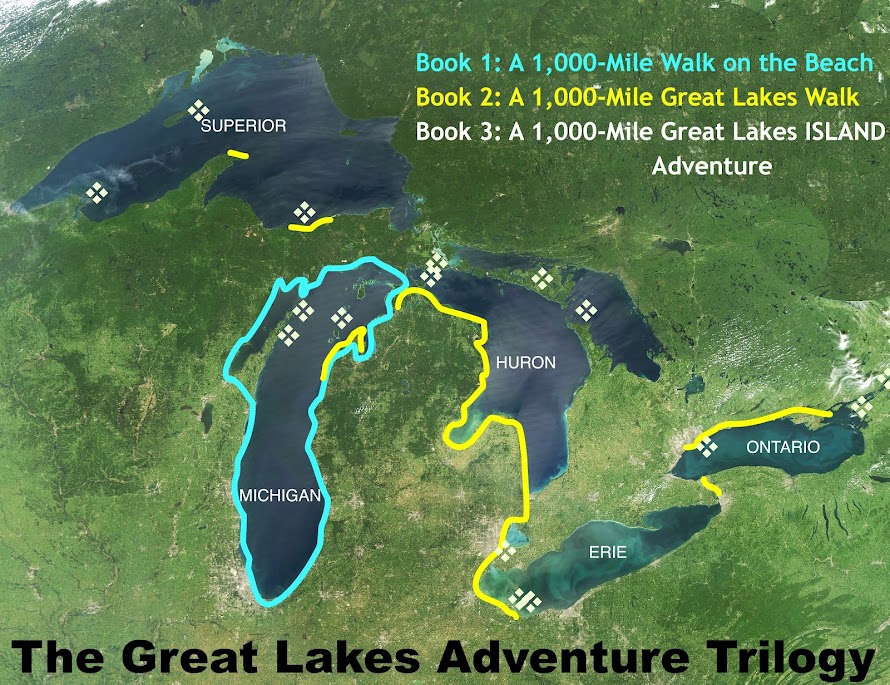
The 1,000 Mile Walk on the Beach may be complete, by my adventure with the lake continues. For one week in November, I'll be living at the Grand Traverse Lighthouse on the tip of the Leelanau Peninsula. They have a volunteer program there where you can stay and work at the lighthouse.

When I hiked this segment of the lake, I ran short on time and had to cut across the peninsula instead of walking to the top where the lighthouse keeps watch over the lake and bay. So, this is my time to explore some of these beautiful miles.

I'll be blogging about this experience and many more that I'll have over the upcoming months as I work on my book A 1,000 Mile Walk on the Beach: One Woman's Trek of the Perimeter of Lake Michigan.

So, check back, and check earlier posts for photos of my Lake Trek.

Friday, October 23, 2009

Tracks in the Sand

There were all sorts of tracks in the sand where I left the prints of my boots. Often, I stopped to take photos as evidence of who had been walking the shoreline ahead of me.

There were scads of deer tracks (below) and at least one bear prowling the shoreline (above).


This track puzzled me for awhile until I saw a crayfish walking the sand leaving these marks behind.


An occasional hoof print where people had ridden in the surf and sand.


There were raccoon tracks, especially near streams.


And, of course, many types of birds left their marks as they wandered the shore.

Wednesday, October 14, 2009

Rock Hound

Most people are familiar with the petoskey stone, a fossilized ancient corral, hexigonaria percarinata, found along the shoreline of NW Michigan (first photo). There are many other fossils to be found on the lake, though. Check out the second photo. I found all of these on my Lake Trek.

There is also a wide variety of rock types and colors in Lake Michigan. Photos 3&4 are of rocks from SW Michigan shoreline. Photo 5 is from the final stretch from Milwaukee to Chicago. One even looks like a fossilized tooth (photo 6).


The final handful are not natural stones at all. This is cast-off slag (the impurities separated out during the refining process) from a steel mill that has been tumbled by the lake for decades.

Around the city of Leland, Michigan, these are called 'Leland Blues.' Local artisans there make earrings and other crafts using these intriguing 'stones.'

The colors of tumbled slag range from turquoise to milky blue and all shades in between.

Invasive Species: The Asian Carp


The Asian Carp has colonized the Mississippi River and devoured most of the other fish in that ecosystem. Boaters on the river are routinely whacked in the face by these fish when they leap out of the water as boats pass by.

These fish can grow up to four feet long and weigh 100 pounds (photo credit: Tennessee Wildlife Resources Agency).

The electric barriers in the Chicago Shipping and Sanitary Canal are in place and active, but there is still a risk that the carp could enter Lake Michigan if the Des Plaines River floods north of the electric gates. This could allow the carp to circumvent the barriers and gain access to Lake Michigan.

In fact, it was a flood that allowed the carp to get into the Mississippi River.

Carp are in the canal just 25 miles from Lake Michigan. If they get into the lake, it's game over for the other fish in the lakes.

Alert your representatives in Congress to this issue at:

http://bit.ly/4y6V6N

Sunday, October 11, 2009

The Great Lakes Restoration Initiative


A House-Senate conference committee now has the funding level of the Great Lakes Restoration Initiative (GLRI) in their hands. The House committee fully funded the initiative at $475 million, but the Senate committee slashed it by $75 million. Hopefully this final committee can restore the funding to its full amount.

The Plain Dealer in Cleveland recently ran an editorial about this topic.

Monday, October 5, 2009

The Hidden Cost of Coal Power

We all use electricity. You're using some right now to to read this. As I walked the lakeshore, I became much more in touch with just where we get our electricity. There are many power plants located on the lake. It makes sense since these facilities heat vast quantities of water to produce steam to turn massive turbines to generate the electricity we use in our homes.

Most of us don't question the power we use-- how is it generated? where is it generated? what impact on our environment does that power plant have?


Each power plant along my hike diverted me from the shoreline--you can't walk on property owned by the power companies, and they are especially sensitive about trespassing around nuclear power plants (I walked around three of these on my Lake Trek). Most of our the power generated around Lake Michigan comes from coal-fired plants like the ones I photographed here (yes, even the last one is coal-fired, located in Michigan City, IN).


Each year in America, coal-fired power plants produce 130 million tons of waste, and most of this is coal ash which is filled with toxic metals such as mercury, arsenic and lead. This waste is stored in containment ponds near the plants and, since these plants are on the lake, the containment ponds are on the lake.

In this first satellite photo, the black area south of the Sheboygan, WI plant is the containment pond. And that pond is right up against Lake Michigan.


In the second photo, Port Sheldon, MI's containment pond snakes around a massive sand dune and ends near Lake Michigan. The black area south of the plant is an enormous mound of coal.

I walked past trains comprised of coal cars that stretched as far as I could see on my Lake Trek. It's time to 'green' our power production before we befoul the lake with a toxic spill.

60 Minutes recently did a piece on the toxicity of coal ash. Check it out HERE.

Wednesday, September 30, 2009

Segment 10 Complete

Segment 10 stretched from Milwaukee to Chicago, a distance of 102 miles.

This brought the total for the Lake Trek to 1,019 miles!


The Lake Trek came full circle, but the adventure continues. I have been writing the book of my journey on breaks between segments. I will now take time to complete and revise that book, A 1,000 Mile Walk on the Beach.

The entire adventure could not be conveyed in this blog format. There is so much more to tell, and my book will be filled with encounters and places and people that would not fit here. There is also an inner journey that took place and that is also best conveyed in the pages of a book.

In November, I will be a volunteer lighthouse keeper at the Grand Traverse Lighthouse north of Traverse City on the tip of the Leelanau Peninsula. I will post reports and photos of this experience.

I will also continue to blog about legislation that concerns the Great Lakes and about efforts to restore the lakes to full health. I'll also revisit the thousands of photos I took along the way and post more of them here. Of course, I'll post updates about the progress of my book and its own journey in the publishing world.

Lake Michigan continues to call me back to its shores and I'll continue to answer and report on 'my' lake. I am filled with an overwhelming sense of completion, and yet there is so much more to accomplish. The long days of walking may be complete, but the writing and reflecting still stretches before me.

So, check back here often. And thanks once again for coming along on my grand, Lake Trek adventure!

Lake Trek Celebration III

Guests of the Lake Trek Celebration stayed at the Sheraton Hotel and Towers located near Navy Pier on the Chicago River.

We had wonderful accommodations and a fabulous cake reception. I chose a chocolate cake with creme brulee filling and Godiva chocolate ganache frosting. BEST CAKE EVER.

I'd like to thank everyone who made the trip to Chicago to celebrate my '1,000 Mile Walk on the Beach.' I could not have completed this adventure without the support of family and friends.


Lake Trek Celebration I

Arrival on Navy Pier then the Lake Michigan cruise on the Kanan Cruise ship!

Thank you to friends, family and fans of Lake Michigan who gathered to celebrate with me!


Lake Trek Celebration II

Photos from the Lake Trek cruise and cake party.


Arrival on Navy Pier!

Here is a video of my arrival on Navy Pier!

video

Segment 10 Day 6 Evanston->Chicago! 11 miles


High of 66 degrees.

Saturday, September 26. The final day of the Lake Trek.

My sister, Leslie, and cousin, Milene, joined me in Evanston for the evening before the last day of the Lake Trek. Then, in the morning, we were joined by my son Ben and his college friends (in first photo from left: Mary, Cristie, Ben, Leslie, Milene, Becca, and Ben). Then, when we were just a couple of miles from Navy Pier, my son, Lucas, and husband, Jim, joined our group.

We had a lovely stroll into Chicago, then onto Navy Pier for the end of the Lake Trek. The final photo here is from a web cam looking out onto Navy Pier. Our group is in the foreground between the brown, square fountain and the row of trees (captured by Stephanie Lyon).

This was a fantastic day to walk. The day was hazy, so the skyline revealed itself in increments as we drew near the city. I was happy to have this group of friends and family walking with me on this final day of my trek around Lake Michigan.

1,000 Miles!

On day five of this segment, I hit the 1,000 mile mark. Here's a short video of the moment.


video

Independent Bookstores Visited


I had the pleasure of visiting two more independent bookstores along this segment. The quaint Lake Forest Bookstore was closed by the time I arrived in town, so I had to press my nose against the glass and just wish I could go in (sorry for the nose print on your window).

Then, in Winnetka, I stopped in at the Bookstall at Chestnut Court. This is a lovely bookstore with a fine selection of books and cards. Both stores looked like they served their communities well.

Check out the links in the sidebar!

Segment 10 Day 5 Lake Forest->Evanston 19 miles


High of 70 degrees.

Friday, September 25


Early in this day, I walked through the city of Fort Sheridan. This was an active military base for almost a century. Troops were mobilized from this base for the Spanish-American War in 1898 to Desert Shield and Desert Storm in the 1990s (and all wars in between). It is now a combination between a museum and a new development with plans to put a golf course in the open land to the north of the parade grounds. There is even a massive model of a red tail hawk's nest (see photo of me sitting on a very large egg).

Just south of Fort Sheridan, there is a fenced off area that was once a dumping site (photo through fence of grazing geese). There are signs along the way forbidding the disruption of topsoil, so there must be some pretty toxic stuff remaining there, and this land goes right up to the lake.

South of this area, I picked up the bike trail that parallels the Metra line for miles. It was nice to see so many kids riding their bikes to school in the morning. In Winnetka, I left the path and walked on Sheridan Road all the way into Evanston where I would spend the last night before finishing my Lake Trek. I was able to get down to the lake at some of the parks along the way. And, in Wilimette, the white, ornate Ba'hai Temple emerged from behind some trees, startling me with its imposing presence (last photo).