The 1,000-Mile Great Lakes Adventures

Showing posts with label Great Lakes Basin. Show all posts

Wednesday, June 10, 2020

Kayaking Cedar Lake

Loreen Niewenhuis is an author, adventurer, and dynamic speaker. 

She has completed a trilogy of 1,000-mile journeys exploring the Great Lakes and has authored three books about these adventures. 


To learn more about her work, or to engage her as a speaker, go to 

http://www.laketrek.com/great-lakes-speaker/


The entire state of Michigan (both upper and lower peninsulas) are in the Great Lakes Basin. This means that every bit of flowing water you see in Michigan is heading to one of four Great lakes (Michigan, Superior, Huron or Erie). 
Check out this map of the Great Lakes watershed:


This is unique. All of the other Great Lakes states and provinces bordering the lakes have only a portion of their lands draining into the lakes. 

Illinois and Indiana have very narrow bands of their state that drain into Lake Michigan, just those portions right along the western and southern edges of the lake. The majority of both of these states drain into the Mississippi watershed. 

I often kayak some of the interior waters of Michigan. One of my favorite small lakes is Cedar Lake. There are always loons there. Little creeks flow into the lake and then flow out to connected lakes. These waters eventually find their way to Lake Michigan.

Enjoy Cedar Lake (west of Traverse City) 
with me:


Remember, these waters are on a journey.


Saturday, January 5, 2013

Slate and Oil...

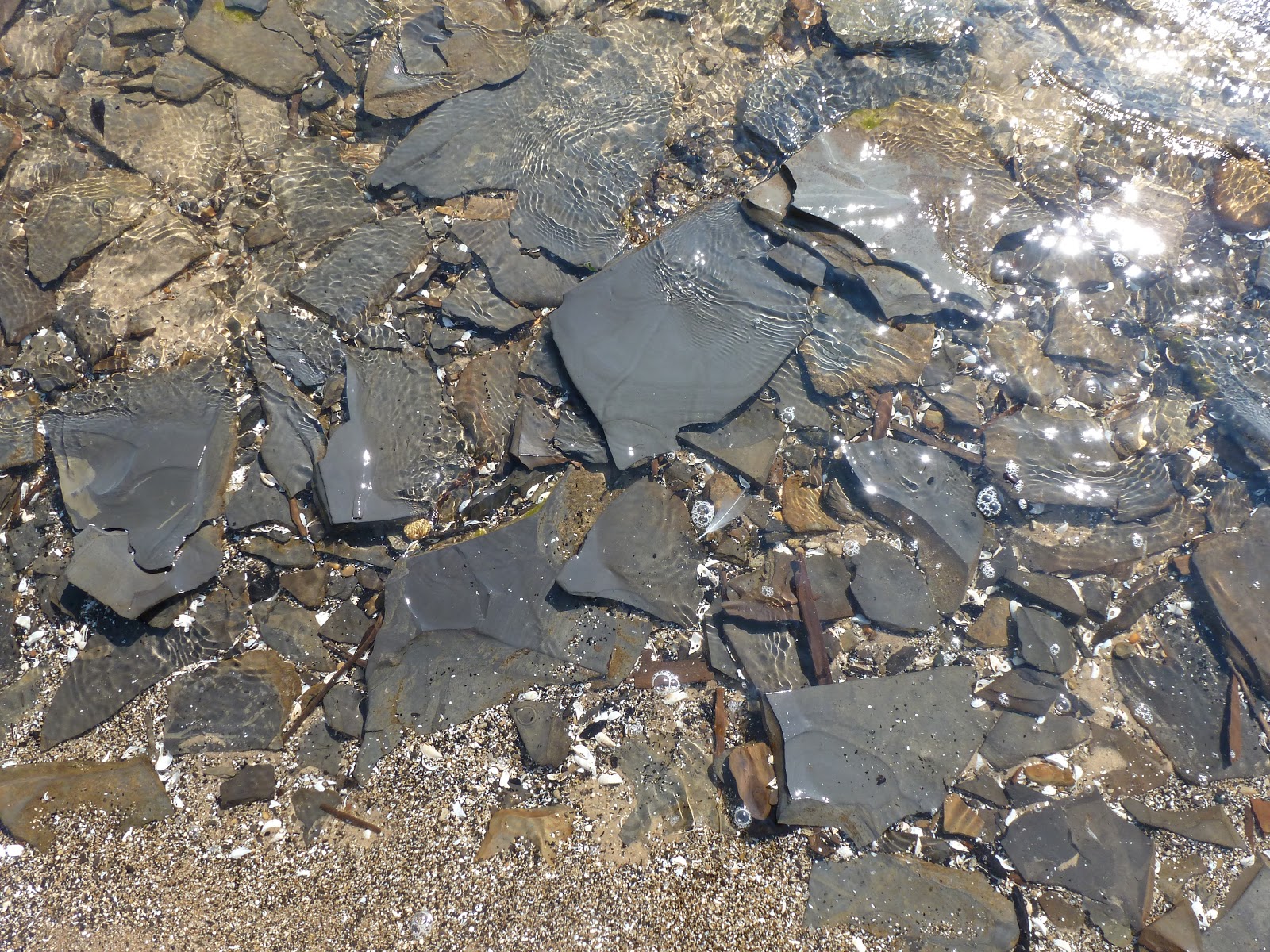
Shale on the shores of Lake Huron


The Great Lakes Basin has a bowl of shale underneath it, nested between other layers (sandstone, limestone, etc.).  

Sometimes the edge of this layer is exposed along the shoreline like near Alpena on Lake Huron and north of Traverse City on Lake Michigan. 

This stone naturally traps oil and natural gas within it, and there are places along the shoreline where oil is seeping out of these rock layers and into the lakes. 

This is a natural process that has been going on around the Great Lakes for thousands of years.


Oil seeps out from the shale layer


The patters are beautiful and colorful...


There are companies that want to frack this layer of shale in Michigan to extract the resources trapped there. 

The companies say that fracking is safe, but they will not disclose everything added to the fracking fluid. 


...as the oil/water mixture merges with the lake.

And the used fracking fluid is so toxic it is disposed of by pumping it deep underground, far underneath the water table.  

In this way, millions of gallons of fresh water are poisoned and removed from use forever.


Sunday, February 26, 2012

A Symphony of Voices for the Great Lakes!


The orange shaded region on the map above represents the Great Lakes basin.
This means that every drop of rain that falls in this area will drain into the Great Lakes and then flow to the North Atlantic Ocean through the St. Lawrence Seaway. Every river in the orange flows into the lakes, everything that is dumped onto the land or waterways here will eventually make its way to the Great Lakes.


The idea of a "Symphony of Voices" is being coordinated by the International Secretariat for Water, a nonprof based in Montreal. They say:

"The Great Lakes–St. Lawrence Symphony is part celebration and part public awareness campaign to bring people together for a shared vision that can help influence policy and the way we treat this precious resource in the future.

The project began in the autumn of 2011 and will run into the summer of 2012. Several interested parties have signed on to partner with the ISW, including members of American Indian and First Nation tribes, regional sustainability groups, Great Lakes United, LSSU, Wayne State University and other universities.

The 1st Great Lakes–St. Lawrence Symphony is an attempt to unite the people who live and work along the hydrological basin of the Great Lakes and St. Lawrence River in an effort to protect this natural resource that plays such a vital role in our lives--from its importance as a shipping channel for commerce, to the fish we catch, and the water we drink."

They are seeking input from everyone in the basin, from scientists and environmental groups, to lake freighter captains, to CEOs of companies whose businesses rely on these waters, to fishermen, to parents who enjoy taking their kids to their favorite beach.
EVERYBODY!

Here are the questions they are asking people to address:

• What unites all of us who live along the Great Lakes/St. Lawrence system?
• What is important to us and what worries us regarding our water?
• What do we want to promote?
• What is our shared vision for 2035?
• What actions should we take to make our vision come true?


Read more about the project HERE
And post YOUR answers to the questions on their BLOG HERE as a comment

The group will gather input to help them form a vision statement for the region.